Select a Solution
Value Systems
Company
Resources
Diligence • Seller Readiness
Why Behavioral Diligence Matters
Financial diligence explains historical performance. Behavioral diligence better predicts whether incentives, decision rights, power structures, and human dependencies will transfer under new ownership.
A business can look clean in diligence and still break after close.
The financials reconcile. Customer concentration is understood. Market growth is acceptable. The model works. Then ownership changes — and suddenly the business no longer produces results with the same consistency, speed, or trust.
That is usually not because the numbers were false. It is because the human operating system was never fully examined.
What behavioral diligence adds
Traditional diligence evaluates assets, liabilities, customers, markets, and historical performance. Behavioral diligence evaluates the human systems underneath performance: incentives, decision rights, power structures, failure modes, and dependencies on specific individuals.
The question is no longer only, “Is this a good business?” It becomes, “Will this business keep producing results after ownership changes?”
Financial diligence validates the past. Behavioral diligence tests whether the operating system is transferable.
The missing layer in most diligence
Most diligence explains historical performance. Very little diligence explains future behavior.
But ownership changes alter incentives, authority, access, status, and trust. When those variables move, behavior moves with them. A business that depended on informal control, founder intervention, or unwritten workarounds may look stable right until the moment those supports are disrupted.
That is why behavioral diligence matters most in businesses that seem to run “smoothly.” Smooth performance can mask hidden dependence on extraordinary individuals, concentrated relationships, or informal escalation paths that do not survive transition.
What transferability risk actually looks like
Founder dependency
The founder is the escalation path, the commercial closer, the cultural stabilizer, and the final interpreter of ambiguity.
The business may be profitable, but it is not yet self-governing.
Transferability issue: results depend on a person, not a system.
Hero culture
A few high-capacity people carry the organization through judgment, relationships, memory, and informal coordination.
The company appears resilient because the heroes are still there.
Transferability issue: capability is concentrated and fragile.
Spreadsheet governance
Decisions are nominally data-driven, but the true operating model runs through private files, side calculations, and manually reconciled numbers.
Reporting may exist without durable control.
Transferability issue: information quality depends on individual effort.
Informal authority
The org chart says one thing. Actual decision power sits somewhere else.
Teams often know who really decides, even when governance documents do not.
Transferability issue: formal redesign breaks hidden control paths.
Relationship concentration
The critical customer, lender, supplier, or employee trust network sits with one or two people whose role carries more continuity than their title suggests.
These are not just operational observations. They are deal risks.
Transferability issue: relationship durability may not survive ownership transition.
Incentives explain more than interviews
Every organization produces the behavior it rewards.
Management interviews matter, but compensation plans, promotion patterns, reporting structures, and resource allocation usually tell the truth faster. If the company says collaboration matters but rewards individual firefighting, you are not looking at a culture problem. You are looking at an incentive design problem.
Behavioral diligence asks simple questions with large implications:
- What behavior gets rewarded here?
- Who gets promoted, protected, or bypassed?
- Where do people go when formal processes fail?
- What does the company tolerate because one person can absorb the cost?
Power mapping matters more than the org chart
Formal structure
Titles, reporting lines, committees, and decision policies describe how the company says it operates.
Actual control
Information access, relationship ownership, pattern recognition, exception handling, and political trust determine how decisions really move.
What to map
Who actually makes decisions, who controls information, who resolves conflict, and who owns the relationships that matter when conditions become uncertain.
Why it matters
Informal power is often more important than formal authority. New owners who redesign structure without mapping power usually destabilize the business they just bought.
Every successful acquisition creates winners and losers
Changes in ownership alter status, access, decision rights, information flow, and perceived future relevance. That creates predictable behavioral responses.
A sophisticated acquirer does not ask only, “Who will support the deal?” The sharper question is, “If this transaction succeeds exactly as planned, who becomes less important?”
Winners need
Recognition, responsibility, and clear stewardship expectations so new authority becomes constructive rather than territorial.
Losers need
Dignity, clarity, and transition support so power redesign does not destroy trust, knowledge continuity, or discretionary effort.
The objective is not to eliminate all resistance. It is to preserve trust while redesigning the power structure of the business.
The transferability test
Can the business operate well without extraordinary effort from extraordinary individuals?
If not, the operating system is not yet transferable.
This does not automatically make the business unattractive. It changes the diligence conclusion. Instead of assuming continuity, the buyer should recognize that part of the value thesis now depends on rebuilding governance, incentives, role clarity, and relationship continuity after close.
That is a very different risk profile than the one the financial model alone suggests.
The real takeaway
Good diligence is not only about proving that the business worked.
It is about determining whether the business will keep working when ownership, authority, and incentives change.
The best acquisitions are not simply profitable. They are transferable.
Related resources
Guide
Commercial Due Diligence for B2B Services
A practical checklist for assessing market attractiveness, customer quality, retention risk, pricing, GTM performance, and growth assumptions.
Read guide →Guide
Evidence Gates in M&A
Convert assumptions into validated decision points before management time, capital, or integration capacity is committed.
Read guide →Tool
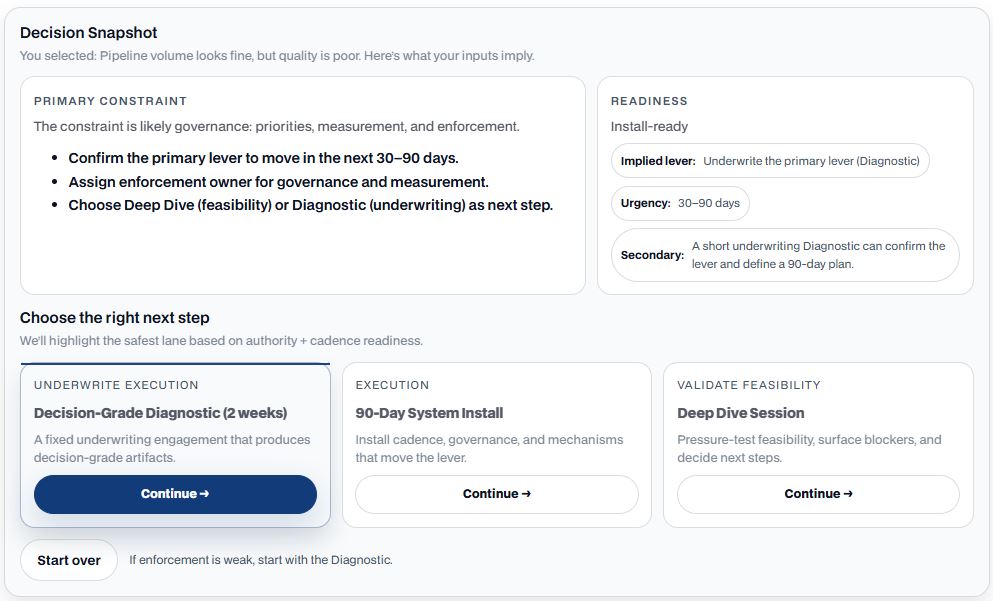
Decision Snapshot
Get a fast read on decision quality, risk, urgency, and the execution path required to move forward cleanly.
Open tool →Next step
Need a clearer view of whether a business is actually transferable?
Goldmont helps leadership teams and deal stakeholders pressure-test assumptions, map decision risk, surface hidden dependencies, and turn ambiguity into evidence-backed action.
For sensitive information: we’re happy to sign an NDA. Please avoid sending confidential details via forms until an NDA is in place.