Engagement Model

Decision-Grade Diagnostic.

Underwrite the lever before anyone commits. Quantify value as ranges, surface assumptions, and set evidence gates—so you can proceed, pause, or re-scope with confidence.

You’ll walk away with Low/Base/High ranges, an assumptions ledger, and an evidence plan built to forward internally—clear inputs, explicit pass/fail criteria, no bloat.

2 minutes to start. No obligation.

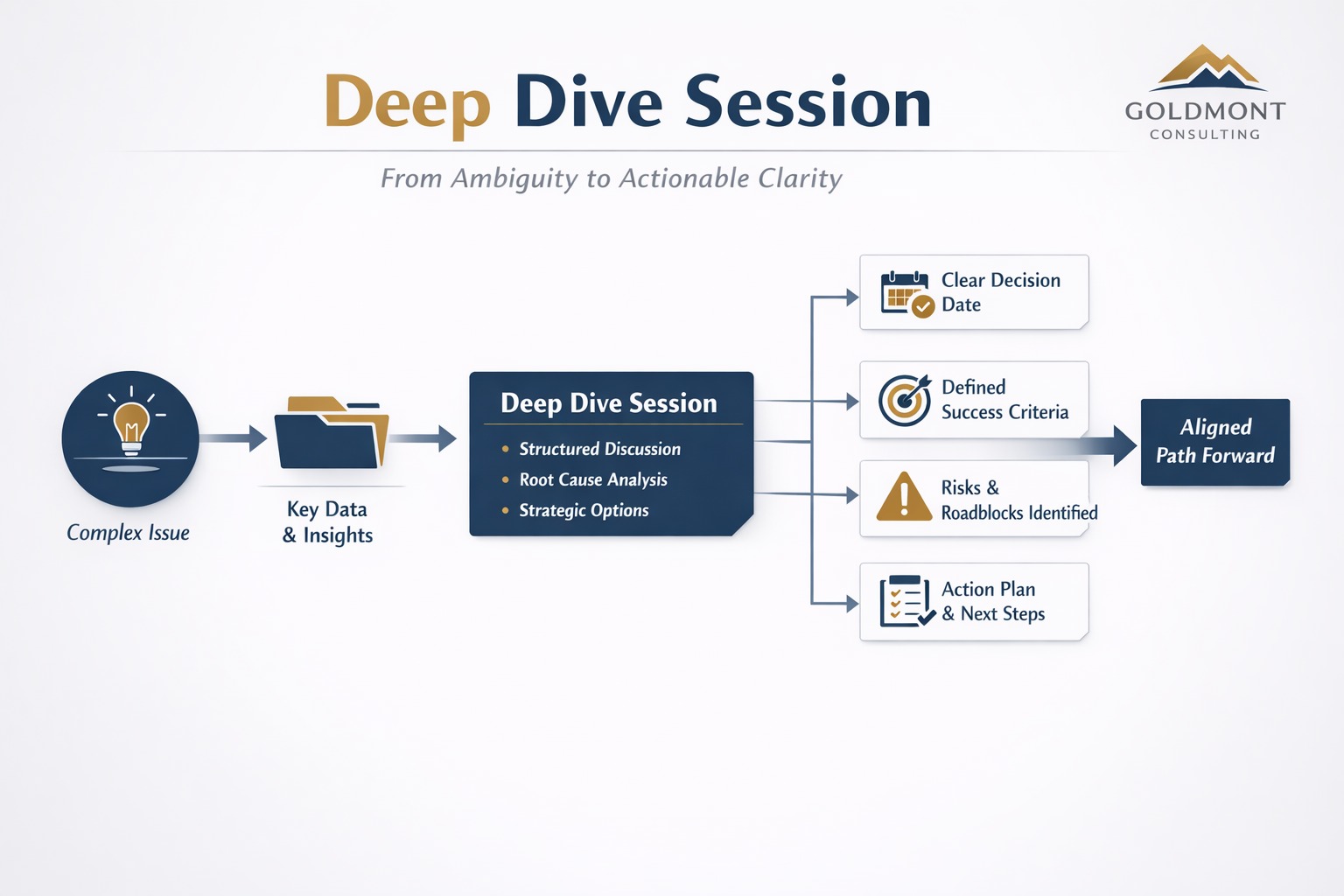
Decision map showing inputs, session structure, and outputs leading to an aligned path forward

Purpose

What it’s for / when to use it

The Diagnostic is the fastest path to a decision you can defend. Use it when the organization needs a clean value range, explicit assumptions, and evidence gates with owners—before you commit budget, headcount, or credibility.

Use it when you need a defendable “yes / no / not yet.”

Best fit

You’re near a decision point and need the case to survive internal scrutiny—without a long diligence cycle.

  • Before funding: confirm the lever and payback band
  • Before building: define what “proof” means and who owns it
  • Before scaling: pressure-test assumptions and stop rules
  • Before cross-functional rollout: make decision rights explicit

Rule of thumb: if the next step requires real spend (or political capital), run the Diagnostic first.

Don’t use it when you already have proof (or a clear owner).

Not needed

The Diagnostic is for uncertainty. If the lever is already validated, you likely need execution support, not underwriting.

  • You already have: baselines, owners, and a validated path to value
  • You’re executing: and just need cadence + controls installed
  • A single-threaded owner exists: with decision rights and an escalation path

In those cases, you’re usually better served by:

  • Deep Dive: convert a validated lever into a run-ready operating rhythm
  • 90-Day System Install: install cadence, scorecards, and controls across teams

Fit

What problems it fits best

Use the Diagnostic when you need to underwrite a lever fast: quantify value as ranges, surface what must be true, and define evidence gates with owners—so the next step is obvious.

Decisions that stall or cycle

Governance

The work keeps moving, but nothing closes—because the decision mechanism isn’t explicit.

  • “We already decided”… and the same debate resurfaces next week
  • Meetings multiply to “get alignment” instead of producing a decision
  • Escalations bounce between leaders with no clear stop point

Goldmont flag

Unrecognized Decision Ownership (UDO): a decision owner is named, but ownership isn’t mutually recognized—so the decision loops instead of closing.

“Big upside” claims without proof

Underwriting

You’re being asked to fund or staff an initiative, but the value case doesn’t survive scrutiny.

  • ROI math is vague (no baseline, no ranges, no payback band)
  • Assumptions are implicit and can’t be pressure-tested
  • No evidence gates to confirm the lever before spending real money

Execution starts before the lever holds

Risk

Teams jump to build, buy, or hire before the prerequisites are validated.

  • “Pilot” scope creep becomes a de facto program
  • Dependencies are unknown (systems, compliance, data, owners)
  • No stop rules if the lever doesn’t validate

Cross-functional work with unclear owners

Operating model

In a matrix, accountability blurs and “helpful input” turns into veto power.

  • RACI exists but no one will commit to a single-threaded owner
  • Stakeholders disagree on who can decide vs. who can advise
  • Hand-offs break because decision rights aren’t paired with cadence

Decision-Grade Diagnostic

What you get (and why it’s decision-grade)

The Diagnostic is built to survive internal scrutiny: ranges before precision, explicit assumptions, and evidence gates with owners—so the next step is obvious.

Decision-Grade Diagnostic

≈2 weeks

Underwrite the lever: quantify value as ranges, surface assumptions, and define evidence gates.

  • Low/Base/High value ranges + payback band
  • Assumptions table (what must be true)
  • Evidence plan: pass/fail gates + owners + sources-of-truth
  • Recommendation: proceed / pause / re-scope
Download: Diagnostic — Process Overview (PDF)
(One page. Forwardable for internal review.)

Use it as an IC appendix or internal memo: clean inputs, explicit owners, and decision-ready outputs.

Inputs (lightweight, explicit)

Stage-gated

You provide only what’s needed to bound value and pressure-test feasibility—no fishing expedition.

  • Problem statement + target decision
  • Constraints (timeline, systems, compliance)
  • Current baseline (volumes, costs, cycle times)
  • Stakeholders + owner for each evidence gate

Timeline + checkpoints

Clear exits

Two weeks, with structured checkpoints so you can stop early if the lever doesn’t hold up.

  • Day 1–2: scope + ranges framing
  • Day 3–7: assumptions + evidence map
  • Day 8–12: pressure test + owners assigned
  • Day 13–14: recommendation + next step lane

Sanitized examples

What the Diagnostic output looks like in the real world

These are sanitized formats people forward internally: value ranges, assumptions ledger, and evidence gates with owners + sources-of-truth.

Sanitized example preview

Forwardable
Low/Base/High ranges • Assumptions ledger • Evidence gates with owners + sources-of-truth

Used as

  • IC / lender-ready appendix
  • Exec decision memo (forwardable)
  • Owner-assigned evidence plan (pass/fail)

Sanitized proof (examples)

“We stopped debating opinions.” The ranges + assumptions made the decision obvious, and the evidence gates assigned owners instead of creating another meeting loop.

Operator + finance stakeholders • multi-system environment

What changes after

  • Fewer “discovery” cycles; clearer scope boundary
  • Risks show up early (data, compliance, owners)
  • Proceed / pause / re-scope becomes defensible

Decision-Grade Diagnostic

Clear scope. Fixed deliverables. No bloated retainer by default.

This is a bounded engagement designed to remove ambiguity before execution: value ranges, assumptions, and evidence gates with named owners.

Decision-Grade Diagnostic

≈2 weeks
From $12,500 (most engagements land $15,000–$25,000) fixed fee (scoped)

Underwrite the lever and produce a forwardable decision packet—so the next step is obvious: proceed, pause, or re-scope.

  • Low/Base/High value ranges + payback band
  • Assumptions ledger (what must be true)
  • Evidence gates: pass/fail criteria + owners + sources-of-truth
  • Feasibility pressure test (data, systems, compliance, resourcing)
  • Recommendation: proceed / pause / re-scope + next-step lane

Risk reducer (how we avoid wasted cycles)

Stage-gated

The Diagnostic is built to stop early when the lever doesn’t hold up—or when the evidence plan reveals constraints that change the decision.

  • Explicit inputs (no discovery fishing)
  • Clear exits at each checkpoint
  • Owners assigned to gates (no orphaned “next steps”)
  • Ranges before precision (no fake certainty)
  • Forwardable format (IC / lender / operator-ready)

If the recommendation is “pause” or “re-scope,” you still keep the artifacts—so the next attempt starts from facts, not vibes.

Optional add-on: If you want a single decision meeting to finalize the lane, the Deep Dive can be scheduled after the Diagnostic. The Diagnostic stands on its own.

Decision-Grade Diagnostic

FAQs (objections, answered)

This is designed for internal scrutiny: explicit inputs, clear owners, and pass/fail gates—so you can move forward (or stop) without drama.

It means the output can be forwarded internally without translation: bounded ranges, explicit assumptions, and an evidence plan with owners + sources-of-truth.

  • Ranges before precision (Low/Base/High + payback band)
  • Assumptions ledger (what must be true)
  • Evidence gates (pass/fail criteria + owner + data source)

Only inputs that bound value and feasibility—no fishing expedition.

  • Target decision + scope boundary
  • Baseline (volumes, costs, cycle time, conversion, etc.)
  • Constraints (timeline, compliance, systems, resourcing)
  • Named owners for each evidence gate

Not by default. We can run async with structured inputs. If a single alignment session is required, it’s scoped and time-boxed.

We can operate with sanitized artifacts and shared inboxes. If naming is required for owners/sources-of-truth, we’ll limit it to what makes the evidence plan executable.

A decision memo / appendix style packet: ranges, assumptions table, evidence gates, and a recommendation with clear next-step lane.

That’s a good outcome. The Diagnostic is designed to produce a clean “pause / re-scope” call early—before you waste cycles on execution.

Next step

Need decision-grade clarity in 2 weeks? Start with the Diagnostic.

The Diagnostic turns uncertainty into ranges, evidence gates, and a board-forwardable decision brief—so you can choose a path (and owners) with confidence.

2 weeks time-boxed From $12,500 Deliverable: decision brief

Not a retainer. If you need a same-week decision, the Deep Dive is the fast-path option.