Select a Solution
Value Systems
Company
Resources
Post-Close Integration • Value Creation
The First 100 Days: Why Integration Is Really About Power, Incentives, and Trust
Most PMI plans focus on systems, reporting, technology, and org charts. The integration work that actually determines value creation happens inside incentives, decision rights, trust, and power transfer.
Close creates possibility. Integration creates value.
That distinction gets missed surprisingly often. Teams prepare Day 1 checklists, systems plans, reporting structures, and org charts — then act surprised when integration friction shows up somewhere else.
Most post-close difficulty does not begin with software. It begins when incentives collide, authority shifts, and the new operating model has not yet earned trust.
What integration is really about
PMI is usually described as a coordination exercise: combine systems, align reporting, redraw the org chart, and install governance. Those tasks matter, but they are not the heart of integration.
The hard part is behavioral. Acquirers and targets are trying to move into a shared operating model while people are recalculating incentives, status, influence, and risk.
Integration succeeds when the new operating system earns trust faster than the old one loses influence.
Why integration failure begins before systems
Most integration failures are explained too late and too technically. The dashboard says adoption is lagging. The steering committee says execution needs more discipline. The project plan says another workstream is delayed.
But the deeper causes usually appeared earlier: unresolved dependencies, conflicting reward systems, unclear decision rights, and unacknowledged power shifts.
In other words, the integration plan looks operational while the real friction is political, behavioral, and human.
The integration dynamics that matter most
The incentive collision
Acquirer and target teams often operate under very different reward systems. One side is rewarded for standardization, cost discipline, and control. The other may have been rewarded for speed, autonomy, and local relationships.
The challenge is not communication. It is behavioral alignment.
Integration risk: people comply formally while defending the old success logic informally.
The power transfer
Every acquisition redistributes authority, information, relationships, and status. Roles that once controlled exceptions, approvals, or customer trust may suddenly matter less.
Resistance is often a rational response to changing realities.
Integration risk: friction is misread as attitude when it is actually a structural response to loss.
Trust resets faster than leaders expect
Teams that worked through history, familiarity, and informal judgment are now being asked to operate through new processes and new people.
Continuity has to be rebuilt, not assumed.
Integration risk: change outpaces confidence, and good people begin hedging instead of committing.
Unclear decision rights create political drag
If no one knows what remains local, what moves centrally, and who has the final call, teams start protecting themselves through delay, escalation, and selective compliance.
Ambiguity becomes a politics engine.
Integration risk: the organization slows not because people disagree, but because ownership never locks.
Winner-loser mapping is not optional in PMI
Every successful acquisition creates winners and losers.
Who gains influence? Who loses influence? The answers predict adoption, resistance, attrition, and political friction more reliably than most integration steering decks.
What winners need
Recognition, ownership, and accountability so new authority becomes stewardship rather than empire building.
What losers need
Dignity, transparency, transition paths, and role clarity so trust does not collapse as power is redistributed.
This is the credit and protection principle in practice. The objective is not to eliminate all tension. It is to preserve trust while the operating model changes.
The first 100 days should do three different jobs
Day 1–14: Stabilize
Focus on continuity, confidence, and visibility. Protect customer trust, preserve operating continuity, and reduce fear-driven interpretation of every change.
Primary goal: stop uncertainty from becoming drift.
Day 15–45: Install operating rhythm
Establish governance, decision rights, accountability, and management routines. This is where integration becomes more than announcements and project tracking.
Primary goal: turn structure into working cadence.
Day 46–100: Build transferability
Remove key-person dependencies, document knowledge, and institutionalize the success modes the combined business will need going forward.
Primary goal: make performance less dependent on memory and personalities.
What not to do
Do not spend all 100 days on system mapping and status reporting while the human operating system remains unresolved underneath.
Primary risk: polished PMI with weak adoption and hidden fragility.
Success mode integration
Strong acquirers do not just map synergies and workstreams. They redesign the operating logic that makes good performance repeatable in the combined company.
One practical sequence is:
- identify the failure mode
- identify the perverse benefit keeping it alive
- trace the incentive system reinforcing it
- map the power structure protecting it
- run winner-loser analysis on the change
- apply a credit and protection plan
- install the new success mode
That is how integration moves from mechanical coordination to durable value creation.
A familiar integration mistake
Systems first, trust later
What usually happens
Leaders push system migration, new reporting, and role changes early because those actions are visible and easy to track. The org appears to be integrating while trust, clarity, and authority remain unsettled.
What controlled integration looks like
Leaders stabilize continuity first, define decision rights early, map power transfer openly, and make systems changes at a pace the business can absorb without losing confidence.
The real takeaway
Exceptional acquirers integrate operating models, not merely systems.
Value creation happens when the new operating system becomes trusted, legible, and repeatable before the old one fully disappears.
The first 100 days matter because they determine whether integration becomes a control system for value creation or a slow-motion loss of confidence.
Related resources
Guide
Day-1 / Day-30 / Day-100 Integration Plan
A practical operating plan for aligning leadership, systems, reporting, priorities, and value capture after close.
Read guide →Guide
100-Day Value Creation Plan
Turn the deal thesis into owners, milestones, KPIs, risks, cadence, and measurable value capture.
Read guide →Tool
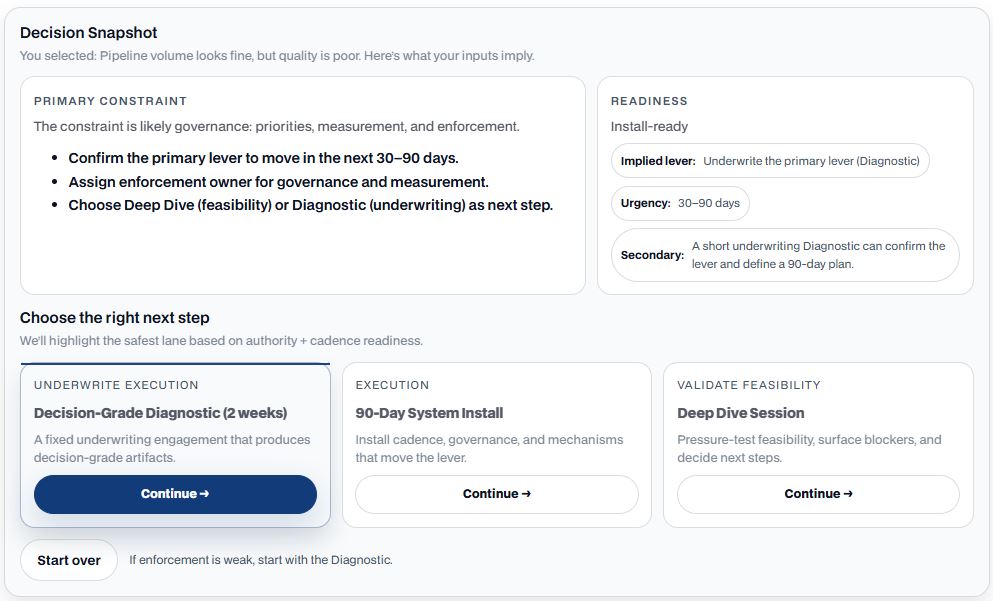
Decision Snapshot
Get a fast read on decision quality, risk, urgency, and the execution path required to move forward cleanly.
Open tool →Next step
Need a clearer integration view for the first 100 days?
Goldmont helps leadership teams and deal stakeholders clarify decision rights, surface hidden dependencies, align incentives, and install the operating cadence required for post-close value creation.
For sensitive information: we’re happy to sign an NDA. Please avoid sending confidential details via forms until an NDA is in place.