Get your business ready to sell in 6 months — with buyer-grade cashflow and controls.
We run a paid Operator Diligence Sprint to stabilize cashflow, lock KPI definitions, and install a weekly decision cadence buyers can trust. A direct majority-buy option is available later if mutual fit and thresholds are met — but the Sprint stands on its own.
Most deals don’t die in negotiation. They die in diligence.
At a glance
A paid diagnostic that produces diligence-ready evidence you can take to market. No obligation to sell.
What makes this safe for owners
- Sprint deliverables are yours to keep
- Clear scope, timeline, and off-ramps
- Improves market-sale leverage (price, speed, retrade risk)
- Direct-buy option discussed only after proof
If your business is profitable but not sellable yet, this is usually why.
Deals stall because buyers can’t quickly underwrite what’s driving cashflow — or how dependent outcomes are on the owner. The same issues show up again and again in diligence.
The pattern buyers read as “risk”
Cashflow opacity
Collections, conversion, and timing are unclear.
Margin leakage
Delivery and pricing drift quietly compound.
Founder dependency
Decisions stall or reopen without you.
Buyers don’t pay for effort or potential. They pay for evidence.
What buyers actually test — and what the Sprint produces
This is designed to make diligence faster, cleaner, and less negotiable.
| What buyers ask in diligence | What the Sprint produces |
|---|---|
| “What actually drives cashflow?” | KPI definitions tied to source systems + weekly scorecard |
| “Where does margin leak?” | Pricing, delivery, utilization, and labor-leak map |
| “How dependent is this on the owner?” | Decision owners + cadence + documented escalation triggers |
| “What could derail close?” | Risk register surfaced early + mitigation plan you can evidence |
Proof first. Optionality later.
The Operator Diligence Sprint is built to convert “owner knowledge” into “buyer evidence.” Clean definitions. Clear ownership. A cadence that forces decisions — and leaves a trail.
The operating premise
“Make the business buyer-ready first. Optional paths come second.”
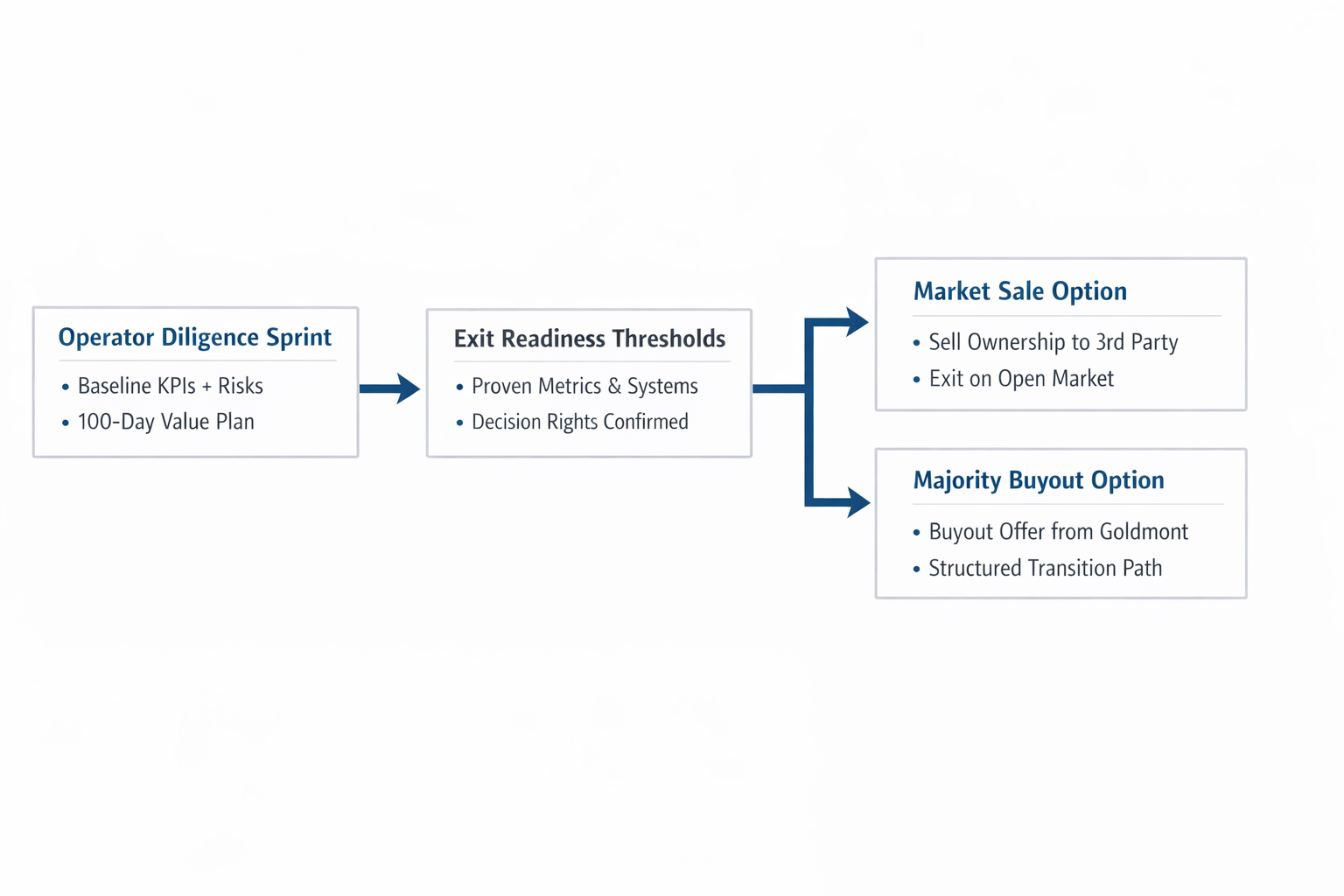
A simple path to a cleaner, faster exit
Sprint first. Evidence second. Optional paths only after proof.
Simple flow
Operator Diligence Sprint → Exit Readiness → (Market Sale or Direct Buy — optional)
Operator Diligence Sprint (2–4 weeks)
Fixed-fee, fixed-scope. Baseline KPIs, surface buyer risk, and produce diligence-ready outputs you keep.
- KPI baseline + weekly scorecard spec (definitions + sources)
- Customer/contract concentration map
- Risk register + diligence memo
- Value-creation plan + 100-day plan
Work-In (optional, 90–180 days)
Embedded operating role to install cadence and controls so improvements show up in trailing evidence — not promises.
- Weekly cadence + owners installed
- Decision gates + escalation triggers
- Measured improvements tracked weekly
Optional paths after proof
Proceed to market with stronger leverage — or explore a pre-wired majority buy option if mutually compelling.
- Market sale readiness (faster diligence, fewer retrades)
- Direct buy path (51%+ control) if fit is proven
- Written triggers + clean walk-away clause
Non-negotiables during Work-In
Decision rights and access aren’t “nice to have.” They are the mechanism.
- Access: full books, contracts, customer mix, KPI dashboards
- Decision domains: pricing, ops process, tech stack/tooling, hiring recommendations
- Cadence: weekly scorecard → decisions → actions
The 4 risks that kill WIBO deals — and how we design around them
1) “Employee trap” risk
No WIBO without written conversion mechanics (option/ROFR/earn-in/price formula).
2) Info asymmetry risk
Diagnostic is mandatory: books access, KPI baselines, concentration, contracts.
3) Seller psychology risk
Triggers + deadlines: “If X by Y date, we execute the option or we walk.”
4) Politics / decision-rights risk
Explicit decision domains in writing: pricing, ops, tech stack/tooling, hiring recommendations.
Who this is for
Owners in Tech Services and Financial Services who want to sell within ~6–12 months and need buyer-grade cashflow clarity, fewer reopened decisions, and an operating narrative that holds up in diligence.
Best-fit signals
- Profitable, but diligence would feel uncomfortable today
- Messy ops + clear margin/cash conversion upside
- Founder is a bottleneck (needs cadence + owners)
- Wants optionality: market exit first, direct buy second
Not a fit if
- You want “marketing motion” or lead gen
- You won’t share books/contracts/customer concentration
- You can’t commit to a weekly decision cadence
- You want outcomes without decision rights changing
Readiness check: If owners can’t be named yet, start with the Sprint and lock scope first.
What you leave with
This is designed to be portable: artifacts you can take to market, not a deck that needs us to explain it.
Sprint outputs (yours to keep)
- KPI definitions + weekly scorecard (sources + owners)
- Cashflow + margin driver map (where leakage actually sits)
- Customer/contract concentration analysis
- Risk register surfaced pre-diligence
- Exit-readiness narrative (what’s true vs what’s improving)
- 100-day plan (controls, cadence, quick wins)
What happens next (only if you choose)
- Market sale: proceed with stronger leverage (faster diligence, fewer retrades)
- Work-In: install cadence and prove improvements in trailing evidence
- Direct buy (optional): explore a pre-wired majority path after proof
Optionality is a feature. The Sprint is the product.
FAQs (objections, answered)
Exit risk + optionality
What if we do the Sprint and you don’t buy?
That’s the expected outcome for many owners. The Sprint is designed to produce buyer-grade clarity you can take to market: clean KPIs, documented risks, and a clear operating narrative that holds up in diligence. If you choose to sell to a third party, you keep everything and use it to improve price, speed diligence, and reduce retrades.
Is this just consulting?
No. Traditional consulting produces recommendations. This produces underwriting artifacts buyers actually test: KPI definitions tied to source systems, documented decision cadence, risk surfaced early, and evidence of control improvements. Some owners take this to market. Others choose a direct-buy path later. The work is the same either way.
How does the majority buyout get priced?
If that path is explored, pricing is pre-wired in writing using a formula or option framework tied to actual performance. But most owners never use this. The primary goal is to create enough clarity and control that any buyer can underwrite the business without discounts or delays.
Controls + access
What access do you need?
The same access a serious buyer will require: financials, contracts, customer concentration, and the ability to stand up weekly KPI reporting with clear definitions. If something can’t be shared now, it will surface in diligence later. The Sprint is designed to surface that risk early — not hide it.
What do you mean by “decision rights”?
Clear ownership over specific operating domains — pricing, delivery process, tooling, and hiring recommendations — with an escalation path when metrics drift. Buyers look for evidence that decisions don’t stall or reopen. Decision rights are how you prove the business can run without the founder.
What types of firms are best?
Businesses where operational evidence materially affects valuation: Tech Services and Financial Services firms with utilization, delivery margin, pricing discipline, quote-to-cash, or retention complexity. If improving operational clarity would change how a buyer prices risk, the Sprint usually pays for itself.
Apply (confidential)
We keep this criteria-driven. If it’s not a fit, we’ll tell you quickly. If it is, we’ll send a Sprint engagement letter and start with decision-grade diligence.
Next steps
- Apply (2–4 minutes)
- 15-minute fit screen
- Operator Diligence Sprint (2–4 weeks)
Prefer email? info@goldmontconsulting.com