Select a Solution
Value Systems
Company
Resources
Diligence • Decision Architecture
Why Execution Fails in PE-Backed Companies
Execution rarely fails because people do not care. It fails because post-close speed accelerates faster than decision rights, evidence standards, escalation thresholds, and operating cadence.
The strategy made sense. The deck was tight. The board nodded at the right moments. Everyone left the meeting thinking, “Okay. We’re aligned.”
Six months later, performance is off plan — and the most common sentence in the business is: “I thought that was already decided.”
This is rarely a strategy problem. It is usually an operating-system problem. Execution fails the way it most often fails in PE-backed companies: quietly, reasonably, and in pieces.
What this is — and what it’s not
This is not a talent critique. It is not a culture diagnosis. And it is not a call for more urgency, more pressure, or more accountability theater.
This is an operator’s explanation of why execution breaks even when capable people are doing their actual jobs: the operating system does not keep up with deal-speed decisions.
Execution isn’t intensity. It’s architecture.
The core dynamic
Speed without control creates noise
PE ownership accelerates everything:
- decisions
- initiatives
- reporting expectations
- end-of-month deadlines
- pressure to show movement quickly
But many companies try to absorb that speed using the same decision rights, the same data discipline, and the same meeting cadence they had before close.
That mismatch creates a familiar feeling: nothing is obviously broken, but nothing is actually landing.
How execution actually breaks
Decisions feel approved — until they aren’t
In many PE-backed companies, decisions pass through three states: discussed, approved, and then reopened “for context.”
Teams hesitate because the decision might change. Two executives both think they own the call. The system never truly locked the decision.
Quiet cost: rework, hesitation, and slow erosion of momentum.
Dashboards look great. Control is missing.
Many companies can produce metrics on demand. Far fewer can answer: where does this number come from, who validates it, and what decision changes if it moves?
When those answers are fuzzy, dashboards become emotional support tools. They inform without forcing action.
Quiet cost: meetings explain the past instead of controlling the future.
Everything is urgent, so nothing moves cleanly
Post-close, the initiative list expands fast: value creation, integration, pricing, margin, systems, quick wins, and one more “critical” item added in a moment of optimism.
When everything is a priority, trade-offs happen silently — usually by people without the authority to make them.
Quiet cost: motion replaces momentum.
Escalation happens only when issues get loud
In many businesses, issues do not escalate when they are small. They escalate when they are unavoidable.
By the time something reaches the board, the variance is locked, options are constrained, and the conversation shifts from control to containment.
Quiet cost: surprises that feel personal, but are actually systemic.
Meetings multiply when ownership doesn’t
When execution starts slipping, the default response is usually more cadence: more meetings, more decks, more alignment.
If a meeting cannot answer what decision is being made, what evidence is required, and what changes if that evidence is missing, it is informative — not operative.
Quiet cost: decision starvation hidden inside a full calendar.
The control shift that actually works
Execution improves when ambiguity is designed out — not when pressure is increased. Four controls consistently restore traction.
Decision architecture
One named owner per decision. Clear separation of recommendation versus approval. Decisions that do not quietly reopen.
Closure is a control, not a vibe.
Evidence gates
A single source of truth. A named validation owner. An explicit consequence when evidence is missing, late, or weak.
Metrics that don’t change decisions don’t count.
Escalation thresholds
Pre-set variance limits. Automatic escalation paths. No discretion required for when the issue must move upward.
Escalation should be boring. Boring is good.
Decision-linked cadence
Meetings mapped to decisions. Inputs required, not optional. Outputs documented, owned, and tracked.
Fewer meetings. More closure.
A familiar example
“Slightly behind, but confident”
What usually happens
The variance is explained. The forecast is updated. Pressure increases next quarter. The underlying control issue stays in place.
What controlled execution looks like
A threshold breach triggers escalation. The miss ties back to a specific decision. Ownership or scope resets. Controls tighten — not just expectations.
The real takeaway
Most execution failures are not dramatic.
They are polite. They are reasonable. They are well-intentioned. They show up as small exceptions, temporary workarounds, and decisions that never fully lock.
PE ownership amplifies whatever system already exists. If ambiguity is allowed, speed magnifies it.
Related resources
Guide
Evidence Gates in M&A
A practical framework for converting assumptions into validated decision points before management time, capital, or integration capacity is committed.
Read guide →Guide
100-Day Value Creation Plan
Turn the investment thesis into owners, milestones, KPIs, risks, cadence, and measurable value capture.
Read guide →Tool
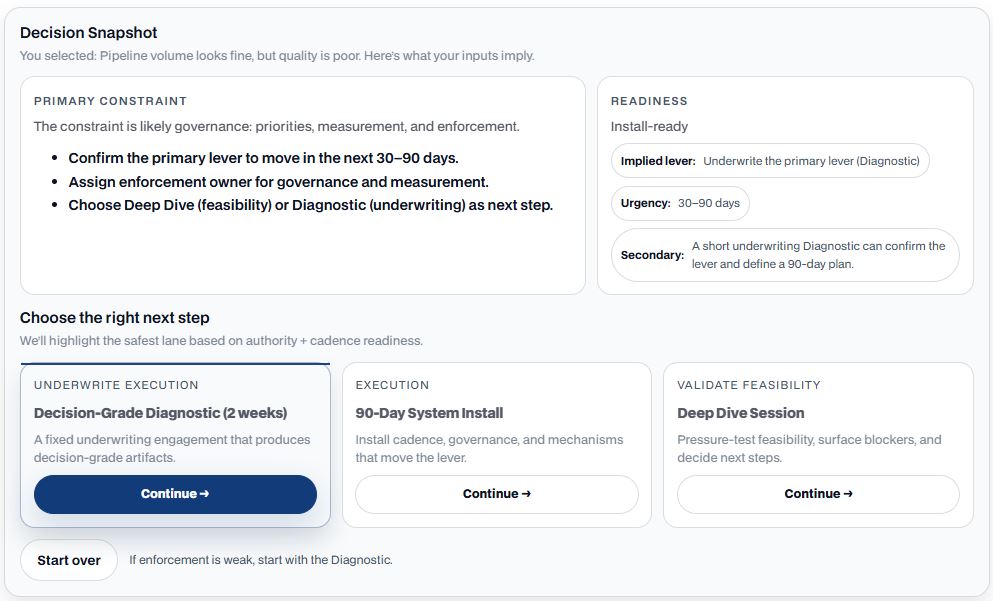
Decision Snapshot
Get a fast read on decision quality, risk, urgency, and the execution path required to move forward cleanly.
Open tool →Next step
Want a decision-ready view of where execution is breaking?
Start with a Decision Snapshot to identify where ownership, evidence standards, escalation rules, and cadence need to tighten — or contact Goldmont to scope the right operating-system intervention.
For sensitive information: we’re happy to sign an NDA. Please avoid sending confidential details via forms until an NDA is in place.