Select a Solution
Value Systems
Company
Resources
Value Creation • 100-Day Execution
Why 100-Day Plans Fail After Week Three
Most 100-day plans do not fail because the thesis was wrong. They fail because the plan is treated like a kickoff artifact instead of an operating system with owners, evidence gates, escalation rules, and decision-linked cadence.
The first week after close feels energetic. The plan is visible. Workstreams are named. Priorities look clear.
By week three, reality starts pushing back. Dependencies emerge. Leadership bandwidth narrows. New issues rise. The plan begins slipping from operating tool to reporting artifact.
That is where most 100-day plans quietly start failing.
What actually goes wrong
Most 100-day plans are good at listing initiatives. They are weaker at governing what happens when those initiatives collide with reality.
A 100-day plan is not a list of work. It is a control system for the first 100 days.
The core dynamic
Momentum fades when the plan does not absorb friction structurally
The early energy of a new plan hides the fact that most initiatives still depend on:
- unclear decision ownership
- weak proof thresholds
- late escalation
- meeting rhythm built around updates instead of decisions
Once those issues show up, the business keeps doing work, but the plan stops controlling the work.
Why the plan breaks after week three
Owners are named, but decisions are not
Initiative owners exist on paper, but the real decisions still depend on shared interpretation or executive rescue.
Milestones are listed without evidence gates
The team tracks progress by activity completed instead of by what has actually been validated or unlocked.
Escalation happens by pain, not by rule
Issues rise only when they become loud enough, which makes intervention later and more expensive.
Cadence turns into status theater
Check-ins multiply, but the forum does not force enough decisions to keep momentum from degrading.
The control layer the plan actually needs
Decision ownership
Each key initiative needs explicit authority on the real decisions that govern progress.
Evidence gates
Before a workstream advances, define what must be true — not just what must be done.
Escalation thresholds
Set trigger points for slippage, risk, dependency, or variance before friction becomes political.
Decision-linked cadence
Make the operating rhythm answer one question repeatedly: what changed, what is blocked, and what needs a decision now?
A familiar example
The initiative that stays “on track” until it suddenly isn’t
What usually happens
The workstream owner reports manageable delay. The same message repeats in two meetings. The issue grows because nobody defined the threshold for escalation or the proof needed to keep confidence intact.
What controlled execution looks like
The variance crosses a pre-set threshold. Escalation happens automatically. The next meeting is built around the decision needed to recover the plan.
100-Day Week Three Reset
Ask these five questions when the plan starts slipping
- Which decisions are still unresolved?
- What evidence is missing for the highest-risk initiatives?
- Which issues should have escalated already?
- Are meetings forcing decisions or just reviewing status?
- Where is the plan visible but not governable?
The takeaway
Most 100-day plans do not die in a dramatic way. They drift.
The fix is not a better kickoff deck. It is a stronger operating layer that keeps the first 100 days decision-ready under real pressure.
Related resources
Guide
100-Day Value Creation Plan
Turn the deal thesis into owners, milestones, KPIs, risks, cadence, and measurable value capture.
Read guide →Article
Why Execution Fails in PE-Backed Companies
Why post-close execution breaks when decision rights, evidence standards, escalation thresholds, and cadence are not designed to keep up with speed.
Read article →Tool
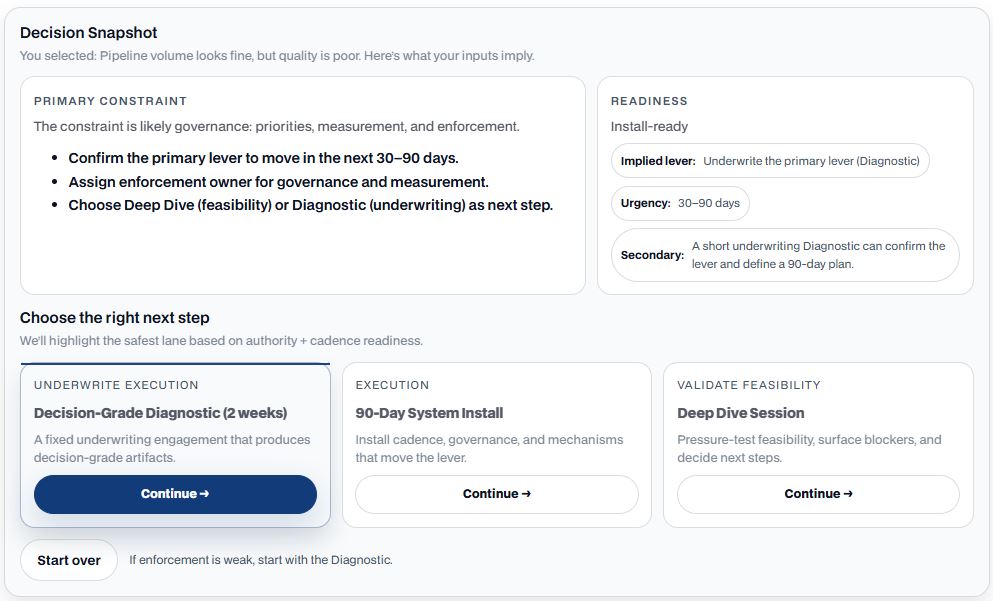
Decision Snapshot
Get a fast read on the decision, risk, urgency, and execution path needed to recover momentum.
Open tool →Source note
This article has been created for Goldmont’s on-site resource library to support the 100-day execution and value creation cluster.
Next step
Need to know why the 100-day plan is visible but not moving?
Start with the 100-Day guide or use a Decision Snapshot to identify where ownership, evidence gates, escalation logic, and cadence need to tighten.
For sensitive information: we’re happy to sign an NDA. Please avoid sending confidential details via forms until an NDA is in place.