Select a Solution
Value Systems
Company
Resources
Operating Model • Process Roles
Untangle the Chaos: Mastering Process Roles for Seamless Operations
Most operating chaos is not caused by bad people or bad intentions. It is caused by unclear roles inside a process: who owns the workflow, who decides, who executes, who validates, and who escalates when reality diverges.
When work gets messy, companies often blame communication. But many “communication problems” are really role problems.
A team does not know who owns the process, who can make the call, who just provides input, or who is supposed to catch the issue before it gets expensive.
That uncertainty creates handoff friction, duplicate effort, hidden trade-offs, and the feeling that everyone is busy while too little actually moves.
What process-role clarity actually solves
Role clarity inside a process does more than improve accountability. It reduces delay, removes avoidable escalation, and makes it easier to see where execution is truly blocked.
Most process friction is not workload friction. It is role friction.
The core dynamic
Processes break when authority, execution, and validation blur together
In many workflows, the same person ends up part owner, part executor, part reviewer, and part escalator. Or worse, nobody knows who any of those people are.
- work gets duplicated
- handoffs become conversational instead of structural
- issues surface late
- leaders get dragged into decisions the process should have absorbed
The process may exist on paper, but the operating roles inside it do not.
Where role confusion shows up
Decision rights are implied, not explicit
People assume someone else has authority, so decisions get delayed or quietly made below the right level.
Execution and review are blended
The person doing the work is also validating it, which makes quality control and escalation inconsistent.
Escalation is personal, not structural
People raise issues based on comfort, seniority, or urgency instead of based on a rule built into the workflow.
Handoffs depend on memory
Work moves because someone remembers to ask, ping, remind, or chase — not because the process carries the transition cleanly.
The role architecture that works better
Process owner
Owns performance of the workflow end to end. Not every task, but the operating integrity of the process.
Decision owner
Has authority over the choices embedded in the workflow. This is often distinct from the process owner.
Execution owner
Performs the work. Needs clarity on inputs, outputs, and what constitutes done.
Validation owner
Confirms that required evidence, quality, or control conditions were met before the workflow advances.
A familiar example
The workflow everyone “owns” and nobody controls
What usually happens
Sales, finance, and operations all touch the process. Everyone can explain their part, but nobody owns the end-to-end flow. Issues get resolved through meetings and heroics.
What controlled execution looks like
The process has one owner. Decisions have named owners. Review points are explicit. Escalation triggers are defined. The workflow becomes inspectable instead of dependent on personality.
Process Role Checklist
Ask these five questions for any high-friction workflow
- Who owns the process end to end?
- Who owns the decisions inside it?
- Who executes each critical step?
- Who validates quality or evidence before the next step?
- What triggers escalation?
The takeaway
Seamless operations do not come from asking people to collaborate harder. They come from designing the workflow so roles are legible, decisions are owned, and escalation is structural.
When role clarity increases, chaos usually falls faster than headcount rises.
Related resources
Guide
100-Day Value Creation Plan
Translate a thesis into owners, milestones, KPIs, risks, cadence, and measurable value capture.
Read guide →Article
Why Execution Fails in PE-Backed Companies
Why post-close execution breaks when decision rights, evidence standards, escalation thresholds, and cadence are not designed to keep up with speed.
Read article →Tool
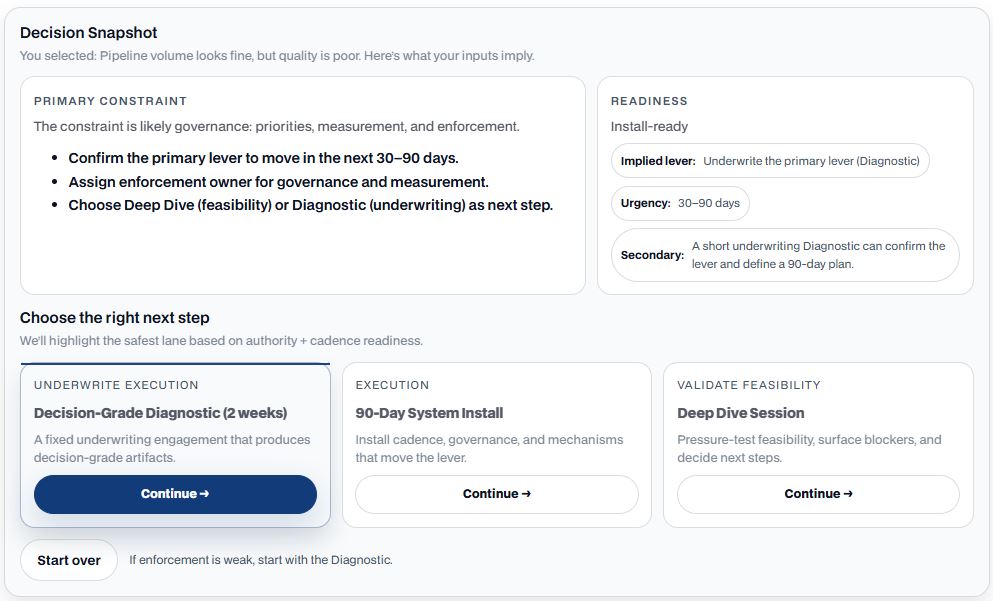
Decision Snapshot
Get a fast read on ownership, risk, urgency, and the decision path required to move forward cleanly.
Open tool →Source note
Originally published by Joshua Durkin on Medium. This version has been adapted for Goldmont’s on-site resource library and may include updated structure, examples, CTAs, and related operating resources.
Next step
Need to know where role confusion is creating hidden execution drag?
Start with a Decision Snapshot to identify where ownership, validation, escalation, and process design need to be clarified before performance improves.
For sensitive information: we’re happy to sign an NDA. Please avoid sending confidential details via forms until an NDA is in place.