Select a Solution
Value Systems
Company
Resources
Finance • Leadership Capacity
Numbers Whisperer Wanted: Hiring the Ideal Fractional CFO
A strong fractional CFO is not just a finance technician. The right one improves decision quality, reporting discipline, cash visibility, forecasting confidence, and leadership bandwidth without requiring a full-time executive hire too early.
Many companies do not need a full-time CFO yet. But they do need better financial judgment, cleaner reporting, and someone who can turn numbers into decisions.
That is where a fractional CFO can be powerful — if the company hires for the actual operating need instead of just the title.
The wrong hire adds overhead. The right one changes the quality of leadership decisions quickly.
What the role should really do
The ideal fractional CFO does more than prepare reports or keep the books organized. The role should help management see the business more clearly and make better decisions sooner.
The value of a fractional CFO is not just financial hygiene. It is decision-grade visibility.
The core need
Most companies do not hire a CFO because they need more spreadsheets
They hire because one or more of these conditions is true:
- cash visibility is too weak
- forecasting is inconsistent
- board or investor reporting is not strong enough
- margin drivers are not understood clearly
- the CEO is still acting as the finance integrator
The right hire should reduce ambiguity, not just increase reporting volume.
What to look for
Operator, not just accountant
The person should understand how finance supports decisions across pricing, cash, margin, hiring, and growth — not just how to close the books.
Communicates clearly with non-finance leaders
A strong fractional CFO translates numbers into business implications without making the room feel like it needs a glossary.
Can build structure fast
The role is often needed because reporting, forecasting, and decision support are not disciplined enough yet.
Knows the difference between a dashboard and a control system
The best finance leaders do not just report. They help define thresholds, actions, and ownership around the numbers.
Common hiring mistakes
Hiring for pedigree instead of fit
A big-company resume does not guarantee the person can help a smaller or faster-moving business build practical finance discipline.
Using the role as a vague executive patch
If the company cannot define what better looks like in 90 days, the role will drift into reactive support work.
Expecting strategy without data cleanup
A great CFO cannot create decision-grade output from messy financial foundations overnight.
Confusing reporting volume with finance maturity
The goal is not more slides. It is better decisions, sooner, with more confidence.
A familiar example
The founder-led company that outgrew spreadsheet finance
What usually happens
The CEO and controller keep the business moving, but cash forecasting is reactive, margin visibility is patchy, and investor updates take too much manual effort. The company knows finance needs to improve, but not exactly how.
What the right fractional CFO changes
Core reporting gets standardized, forecasting becomes more credible, investor and board communication tightens, and finance starts functioning as a decision support system instead of a monthly scramble.
Fractional CFO Hiring Checklist
Before hiring, answer these five questions
- What decisions should finance improve first?
- What reporting gaps create the most risk today?
- What would better look like in 90 days?
- Does the role need strategy, structure, or both?
- Who will own the internal follow-through?
The takeaway
The ideal fractional CFO is not a prestige hire. It is a leverage hire.
The best one helps leadership convert finance from backward-looking reporting into forward-looking operating clarity.
Related resources
Article
Your Data Journey Begins
How leadership teams move from fragmented reporting to decision-grade, AI-augmented executive visibility.
Read article →Article
Why Execution Fails in PE-Backed Companies
Why execution breaks when decision rights, evidence standards, escalation thresholds, and cadence do not keep up with speed.
Read article →Tool
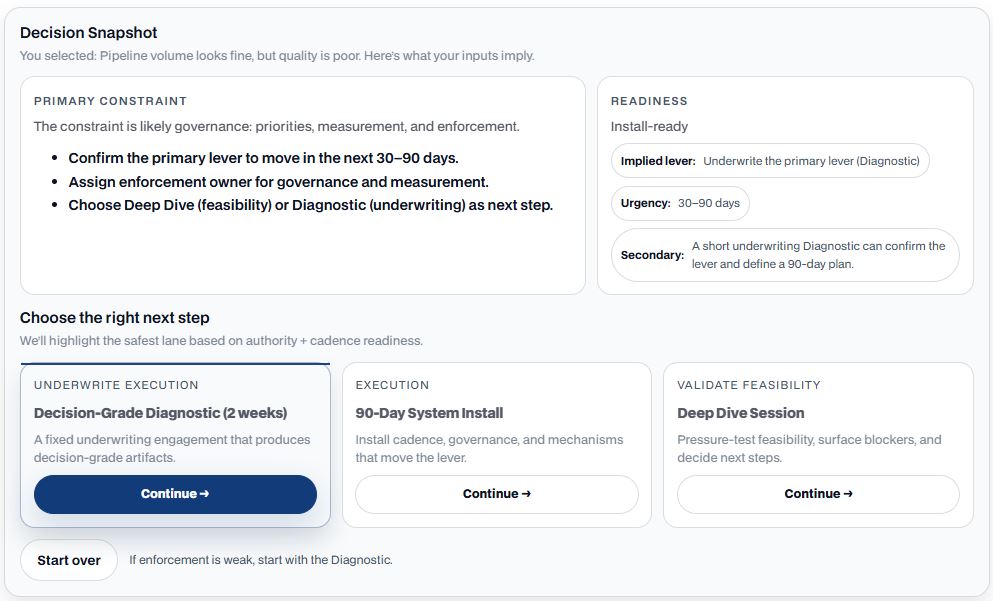
Decision Snapshot
Get a fast read on where reporting, ownership, and decision quality need to tighten first.
Open tool →Source note
Originally published by Joshua Durkin on Medium. This version has been adapted for Goldmont’s on-site resource library and may include updated structure, examples, CTAs, and related operating resources.
Next step
Need to clarify whether finance leadership is the bottleneck — or the unlock?
Start with a conversation about where better visibility, forecasting, and decision support would create the most leverage for the business.
For sensitive information: we’re happy to sign an NDA. Please avoid sending confidential details via forms until an NDA is in place.