Select a Solution
Value Systems
Company
Resources
Diligence • Seller Readiness
How AI Changes Diligence (What Sellers Must Prepare)
AI does not change the purpose of diligence. It changes how quickly buyers surface inconsistencies, test claims across sources, and assess whether a business is durable enough to underwrite with confidence.
Most sellers think diligence is a document scavenger hunt. Buyers see it differently.
Buyers think of diligence as risk pricing: what can go wrong, how likely it is, and what protections are required in structure and price.
AI does not change that goal. It changes the speed, depth, and consistency with which buyers get to the answer.
What this means for sellers
AI in diligence compresses the time between first access and first pressure. What used to take weeks of manual review can now take days to surface.
That means diligence becomes faster and less forgiving. You feel the pressure earlier in the process, and the best defense is not spin. It is readiness and clarity.
The goal is not to build a perfect company. The goal is to remove avoidable friction and make risk legible.
How AI is changing diligence
Buyers can find gaps faster, triangulate claims harder, and inspect durability more deeply
AI accelerates the first pass across thousands of files: contracts, payroll reports, invoices, customer lists, support tickets, policies, and more.
That lets buyers surface issues earlier, ask sharper follow-up questions sooner, and test whether the narrative holds across multiple sources.
- missing agreements
- inconsistent customer terms
- odd revenue-recognition patterns
- margin volatility that does not match the story
- concentration risk that was not clearly explained
Consistency matters more than eloquence. If your metrics live in three different places with three different answers, buyers will assume the worst until you prove otherwise.
Where sellers get exposed
Diligence is faster and less forgiving
Buyers no longer need as much manual time to surface missing documents, inconsistent patterns, or unexplained anomalies.
That means the process feels harder earlier. Gaps that used to emerge late now show up near the start.
Your story gets triangulated across sources
A seller may say churn is low or pricing is stable. AI lets a buyer cross-check that against billing exports, CRM snapshots, cohort views, contract terms, support trends, refunds, and credits.
The issue is not just whether the claim sounds good. It is whether the claim survives cross-source comparison.
Patterns become the new diligence weapon
AI is good at finding customer-by-customer margin differences, discount drift, turnover concentration, vendor spend creep, project overruns, and seasonality masked as volatility.
“We think it’s fine” is much weaker when the pattern is visible at scale.
The focus shifts toward operational durability
As financial anomalies become easier to find, competitive buyers spend more attention on whether revenue is repeatable, delivery is stable, the owner is removable, and outcomes are measurable.
SOPs, KPIs, and governance start to function like de-risking assets.
What sellers should prepare now
This is not about creating a perfect data room. It is about making the business easier to review and harder to misunderstand.
Data room hygiene
Use a clean folder structure by diligence category, consistent file naming, one data-room index, and clear version control. Avoid scattered PDFs, unexplained missing months, and “final_v7_REAL_FINAL.xlsx.”
Financial clarity
Prepare monthly P&Ls, a revenue bridge, an EBITDA bridge, working-capital basics, customer concentration views, and short notes explaining any unusual quarters before a buyer asks.
Contract readiness
Keep customer templates, top customer agreements, renewal schedules, pricing practices, vendor contracts, leases, debt, and unusual obligations accessible and organized.
Operational proof
Bring short SOPs, an org chart, clear role ownership, monthly KPIs, and a systems map. Durability is easier to underwrite when the company looks like a business, not a founder memory palace.
A familiar example
Seller narrative vs. buyer triangulation
What usually happens
A seller says the business has low churn, stable margins, and clean renewals. The presentation is persuasive, but the support sits in multiple systems with inconsistent definitions and little reconciliation.
What buyer-ready preparation looks like
The seller can show how the claim ties across billing, CRM, contract terms, retention patterns, discounts, and support history. The point is not polished language. It is durable, cross-source consistency.
The seller-ready checklist
If you do nothing else, do these ten things
- One clean folder structure and index file
- Monthly financials for 24–36 months
- Revenue and EBITDA bridge with honest explanations
- Customer concentration list and renewal status
- Top customer contracts in one place
- Vendor contracts and unusual obligations
- Org chart and role ownership
- SOPs for the core workflow
- Systems map and access-control basics
- A one-page memo on what could worry a buyer and why it is manageable
How sellers can use AI on their side
Sellers can use AI carefully to improve readiness without introducing new risk.
- build a data-room index and checklist
- summarize contracts for internal review
- find inconsistencies in naming and dates
- draft a known-issues and mitigations memo
- build a Q&A log so answers stay consistent
AI is useful as a drafting and organizing assistant. It is not a substitute for verified diligence truth.
The takeaway
AI is changing diligence by making it faster, deeper, and more pattern-driven.
Sellers who still treat diligence as a reactive file hunt will feel more pressure sooner. Sellers who prepare clear evidence, organized documentation, and durable explanations will move through the process with less friction and more credibility.
The best seller preparation is not polish. It is legibility.
Related resources
Guide
Commercial Due Diligence for B2B Services
A practical checklist for assessing market attractiveness, retention risk, pricing, customer concentration, GTM performance, and growth assumptions.
Read guide →Article
Boards Don’t Need More Data — They Need Evidence Gates
Why decision-grade evidence, validation ownership, and escalation thresholds matter more than thicker board packets.
Read article →Tool
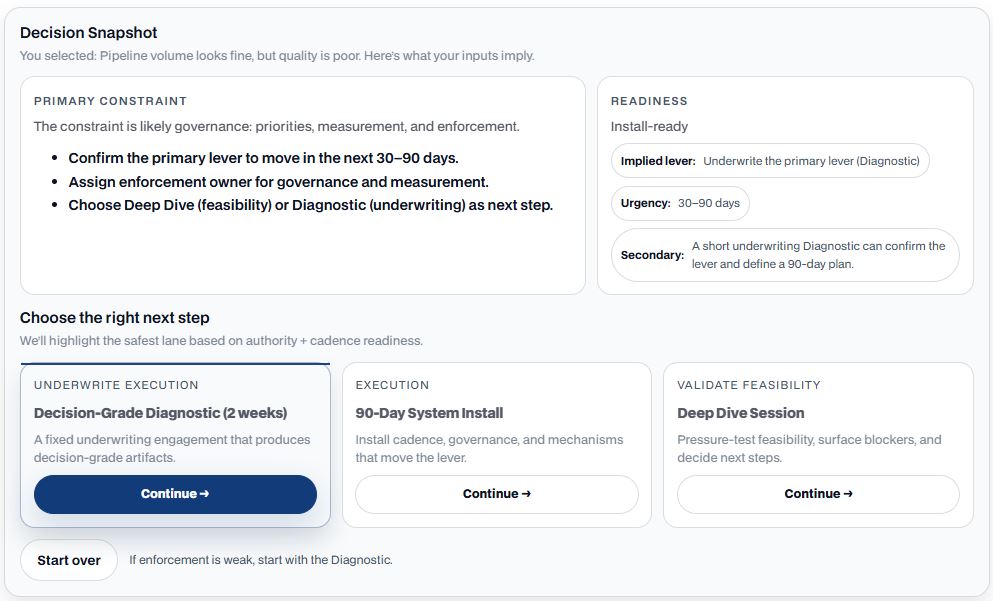
Decision Snapshot
Get a fast read on risk, urgency, evidence quality, and the execution path required to move a decision forward.
Open tool →Source note
Originally published by Joshua Durkin on Medium. This version has been adapted for Goldmont’s on-site resource library and may include updated structure, examples, CTAs, and related operating resources.
Next step
Need a clearer view of what a buyer will pressure-test first?
Start with a Decision Snapshot to identify where your story, evidence, file structure, and operational readiness may create avoidable diligence friction.
For sensitive information: we’re happy to sign an NDA. Please avoid sending confidential details via forms until an NDA is in place.