Select a Solution
Value Systems
Company
Resources
Value Creation • Decision Closure
CEOs Waste 20–40% of Their Time on Alignment. Here’s the Fix.
Alignment expands to fill executive time when decisions do not travel cleanly. The fix is not more communication. It is stronger closure through ownership, evidence, escalation rules, and decision-linked cadence.
Most CEOs do not say they are spending too much time on alignment.
They say things like: “I keep repeating the same priorities.” “We agreed on this, but execution still diverged.” “I thought this was clear.”
Calendars fill with alignment meetings. Pre-reads get longer. Language gets tighter. And yet the CEO remains the human middleware — reconciling interpretations, resolving friction, and restating decisions that were supposedly made.
What this is — and what it’s not
This is not about poor communication. It is not about low trust. And it is not about teams “not getting it.”
It is about why alignment work expands to fill executive time when decision systems do not close — and how a small structural shift gives that time back.
Alignment isn’t the goal. Alignment is the tax you pay when decisions don’t travel cleanly.
The core dynamic
Alignment fills the vacuum left by weak decisions
Alignment becomes necessary when decisions do not fully resolve three things:
- who owns the call
- what success evidence looks like
- what happens if reality diverges
When those are unclear, interpretation steps in. Each layer adds its own version. The CEO becomes the final interpreter.
Most alignment meetings are really decision-repair meetings.
Why alignment keeps consuming executive time
Decisions do not close hard enough to travel
Leaders leave the room with broad agreement, but without a fully closed decision. Work moves forward under interpretation, not under control.
Two weeks later, execution diverges and the CEO steps back in to restate what should already have been settled.
Quiet cost: repeated explanation work instead of progress.
Ambiguity feels flexible, so it survives too long
In fast-moving environments, ambiguity can feel useful. It leaves room to adapt. But it also leaves room for every layer to interpret the decision differently.
What looks like flexibility at the top becomes drift in execution.
Quiet cost: local versions of the same priority.
Escalation feels political instead of automatic
Teams often avoid escalating early because the thresholds were never defined clearly enough. It feels safer to ask for another alignment meeting than to trigger a formal reset.
The CEO gets pulled back in because the system never made escalation boring.
Quiet cost: executive time spent reconciling instead of deciding.
More forums get added instead of stronger decisions
When alignment problems persist, many teams add more check-ins, more working sessions, and more cross-functional reviews.
The result is not cleaner control. It is more calendar load around decisions that still do not close.
Quiet cost: the appearance of coordination without actual closure.
The fix: replace alignment with closure
The goal is not better alignment. It is decisions that close hard enough to travel without executive supervision. That requires four controls.
Decision ownership
One named owner per decision. A clear distinction between input and authority. No consensus theater.
If everyone owns it, no one does.
Decision evidence
Define the evidence required to decide, and name one validation owner. Most debates persist because the evidence standard is implicit.
No decisions made on vibes.
Escalation rules
Set pre-defined thresholds for when reality diverges. Escalation should trigger automatically, without requiring a political judgment call.
Escalation shouldn’t require courage. It should require math.
Decision-linked cadence
Meetings should exist to decide, not to align. Outputs should be documented, owned, and prevented from quietly reopening.
Meetings multiply when closure doesn’t.
A familiar example
Alignment vs. closure in practice
What usually happens
The CEO restates priorities quarterly. Leaders interpret locally. Divergence appears. The CEO steps back in to realign. Everyone leaves feeling better, and the cycle repeats.
What controlled execution looks like
Priorities are converted into explicit decisions. Evidence gates are defined upfront. Escalation triggers before drift hardens. The same leadership team needs less alignment work because the system carries more closure.
A practical 7 / 30 / 90 reset
Surface the drain
Track where CEO time is spent “realigning.” Identify the 10 decisions driving that time. Name where ownership, evidence, or escalation logic is weak.
Rebuild the decisions
Assign single decision owners. Define minimum decision-grade evidence. Install escalation thresholds before the next round of drift.
Remove the CEO
Test decisions without CEO presence. Escalate only on rule breaches. Lock standards into operating cadence so the system carries the work.
If the CEO is still required, the decision isn’t finished
The signal is not whether the meeting felt aligned. The signal is whether the work can continue cleanly without executive re-translation.
Decision Closure Audit
Use a simple closure audit before adding another alignment forum
For any recurring alignment issue, ask: who owns the decision, what evidence is required, what triggers escalation, and what forum actually closes it? If those answers are missing, the issue is structural, not interpersonal.
The takeaway
CEOs do not lose time to alignment because they communicate poorly. They lose time because the operating system quietly requires them to stay in the loop longer than they should.
Alignment work expands when decisions do not close cleanly enough to travel through the business without executive translation.
The fix is not more alignment. The fix is more closure.
Related resources
Article
Why Execution Fails in PE-Backed Companies
Why post-close execution breaks when decision rights, evidence standards, escalation thresholds, and cadence are not designed to keep up with speed.
Read article →Guide
100-Day Value Creation Plan
Translate a deal thesis into owners, milestones, KPIs, risks, cadence, and measurable value capture.
Read guide →Tool
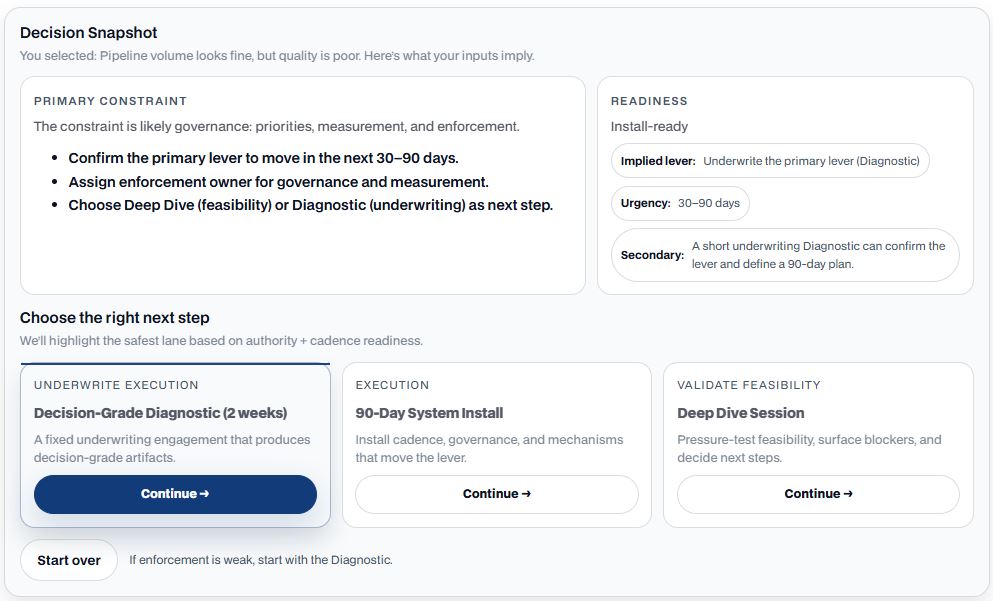
Decision Snapshot
Get a fast read on the decision, risk, urgency, and execution path needed to move forward without alignment drag.
Open tool →Source note
Originally published by Joshua Durkin on Medium. This version has been adapted for Goldmont’s on-site resource library and may include updated structure, examples, CTAs, and related operating resources.
Next step
Want to reduce alignment drag without adding more meetings?
Start with a Decision Snapshot to identify where ownership, evidence standards, escalation rules, and cadence are forcing the CEO back into decisions that should already travel cleanly.
For sensitive information: we’re happy to sign an NDA. Please avoid sending confidential details via forms until an NDA is in place.